Airports have been very busy over the past couple of weeks, as they always are during school holidays. For most travellers, this is a time of excitement, but for a significant minority, it is a time of real dread.
A poor night’s sleep the night before travelling or delays at the airport only make the problem worse. If thinking about an upcoming flight makes your heart rate increase, your chest tighten, or your stomach spasm up you are not alone; anxiety around flying is a very common problem.
Fear of flying, also known as aerophobia, is one of the most common fears people seek my help with. Some clients feel embarrassed admitting to others they are terrified of flying. Others are desperate to avoid their children ‘learning’ their phobia, which adds additional pressure and compounds their anguish.
Flying phobia can affect people from all walks of life, including those who are confident and capable in other situations.
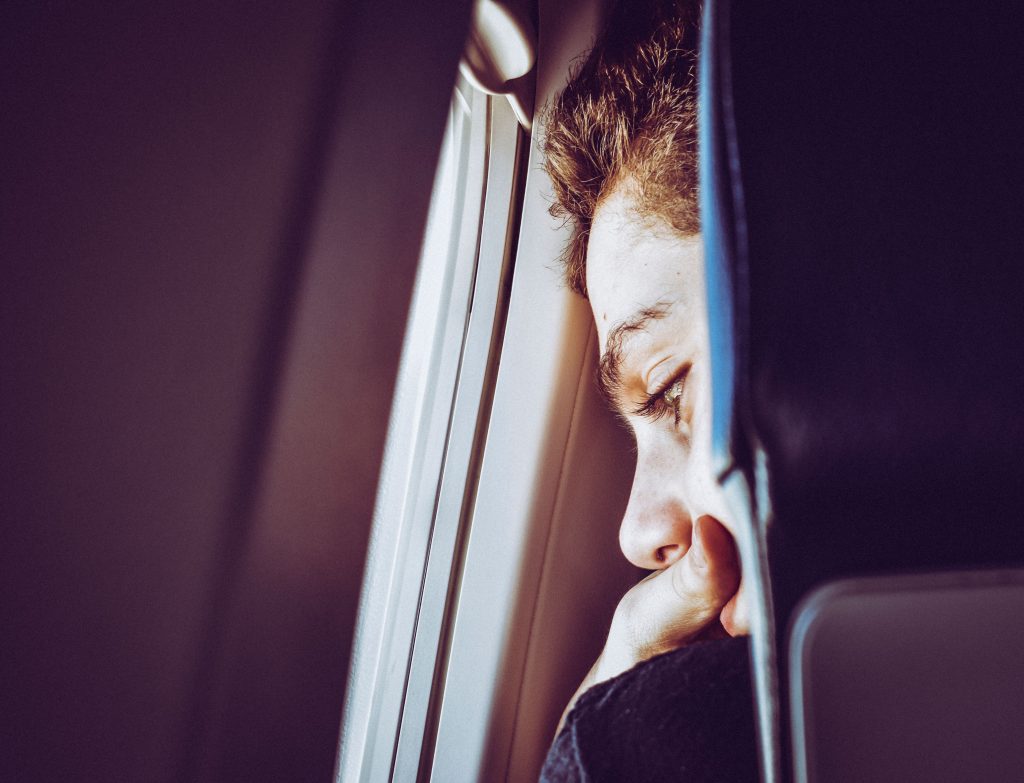
Why people fear flying
The reasons people are afraid of flying vary considerably.
As a therapist, it’s important not to make assumptions about what is driving any fear. So, I typically begin by establishing whether the fear relates specifically to flying, extends to travel and transport more broadly, or is instead connected to Generalised Anxiety Disorder (GAD). Knowing whether someone’s anxiety is narrow and specific, or part of a wider pattern, helps to shape the treatment approach I take.
If it’s specific to flying, I seek to understand what ‘the fear below the fear’ is.
Whilst they may have theories about why they are anxious about air travel, many clients aren’t sure of the root cause. It may stem from an earlier turbulent flight, claustrophobia, a fear of becoming unwell during the journey or most common of all, the fear of being out of control.
In my experience, fear of crashing is comparatively rare. The good news is that I have reliable strategies to reduce or eliminate anxious thoughts and physical.
Fear of losing control
Anxiety feeds on the belief that nothing can be done and that the individual has no control over their situation.
The fear of being out of control (or losing control) is familiar to everyone who experiences anxiety. Truth be told, we are in control of very little. See my blog called Stress, anxiety & the myth of control for useful tips. It’s worth pausing to reflect on this for a moment as it’s fundamental to changing your mindset and future experiences.
Acceptance of what you can’t control whilst being confident about what you can, is the starting point for change. It is integral to experiencing a sense of control.
How hypnotherapy can help
Most of my clients appreciate on an intellectual level that flying is statistically very safe. They know logically that most things they might catastrophise about (the ‘what ifs’) are unlikely to happen.
Unfortunately, that knowledge rarely changes how they feel.
Fear is not a logical problem, it is an emotional one, held at a level that facts and statistics don’t fully penetrate. That’s why hypnotherapy is an ideal therapy for phobia treatment and is recommended for irrational or exaggerated fears. Most clients find it very relaxing and pleasant as well as effective.
Effective self-help strategies
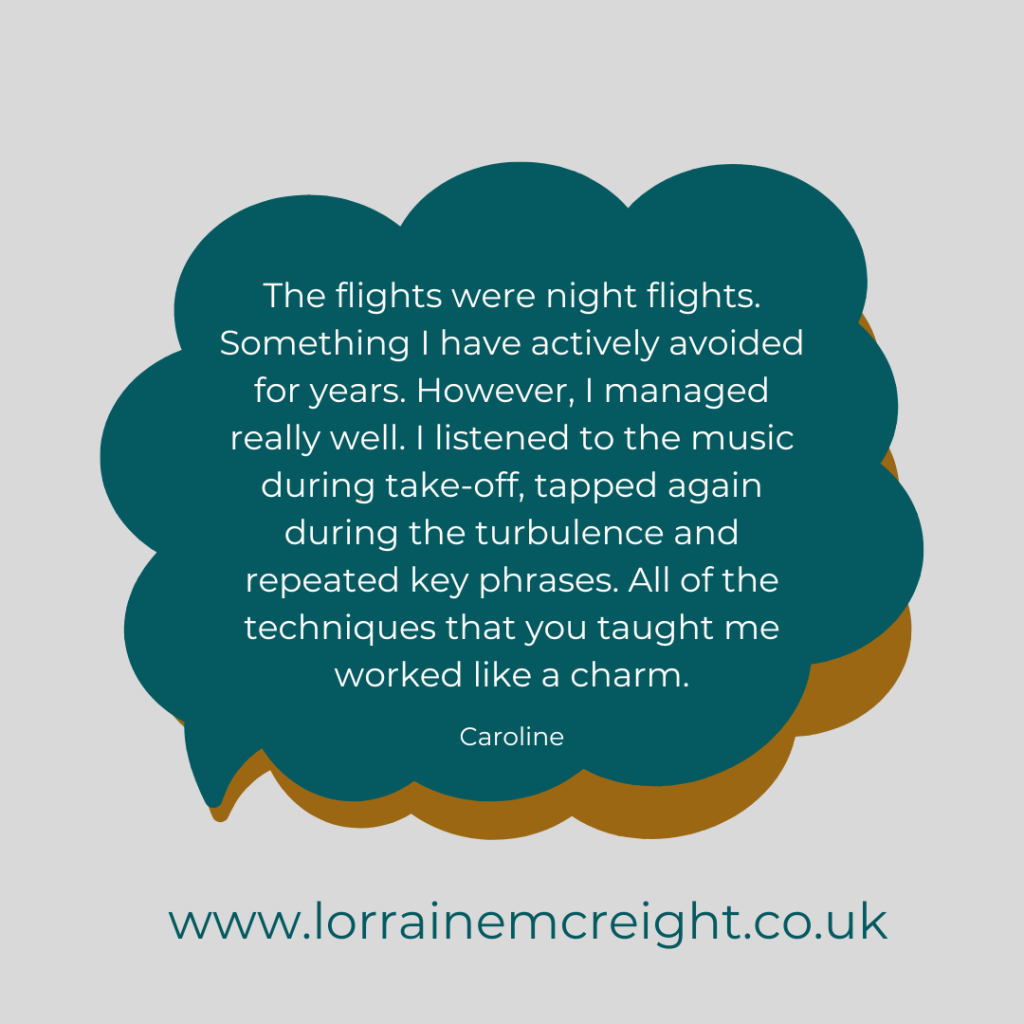
In conjunction with my hypnotherapy sessions, I teach my clients self-help strategies they can practise independently. These include easy-to-learn breathing practices to regulate the autonomic nervous system, tapping techniques to interrupt anxious thoughts and reduce unwelcome physical symptoms, and relaxation routines that can be used discreetly in an airport or on board.
These practical tools can break old patterns and make a real difference. They can also engender a welcome sense of control and agency.
I recommend that my clients practise a short routine in the weeks leading up to a flight, not just during it. I consider the techniques I teach as ‘preventive’ as well as ‘first aid’.
Approaching flying in a calmer state is preferable to managing full-blown panic once on board. But most of my nervous system regulation strategies can be used quietly, quickly, and without drawing attention, when you are sitting in a departure lounge or fastening your seatbelt as the doors close.
Do not wait until the last minute
If you already have a flight booked my advice is not to push it to the back of your mind.
It may feel easier in the short term to avoid thinking about it (or tell yourself you feel okay this time) but anxiety left unaddressed tends to build quietly in the background and intensifies as the departure date approaches.
You’ll be better able to master the techniques I advocate before the anxiety builds and you are experiencing unpleasant symptoms.
New clients often contact me a week before a holiday flight when they are already in a semi-agitated state. Seeking help early gives you time to make real progress and gain confidence in your new skills before you are packing your bags or standing at the departure gate.

A realistic timeline
If you are one of the many folks who hates flying, I recommend that you book to see me well in advance of your next flight.
Ideally, I like to start work before any flight is in the diary. This gives us an opportunity to work while you’re in a calm state of mind.
You’ll find it is easier to learn self-hypnosis, stress-reduction strategies, and anxiety-reducing protocols at this stage. This means that you’ll be able to draw on these more readily when needed, rather than struggling to remember what you’re meant to do when the wheels start to fall off or panic sets in.
You’ll also be more receptive to hypnotic suggestion when you’re not battling anxious thoughts.
If the thought of flying takes the joy out of holidays . . .
I offer:
- One-to-one therapy sessions
- Intensive therapy retreats
- A confidential consultation to explore whether we’re a good fit
Book a call with me, I’d love to hear from you.
Featured image by Patrick Konior on Unsplash